
If ‘year‑round use’ and ‘higher value’ caught your eye, picture this: you tap a button on a breezy, 48-degree Saturday and the enclosure glides open just enough to keep warmth in and wind out. No leaves, no pollen, no scramble for covers. The water’s ready. Safe entry, clear sight lines. At a showing, buyers feel that comfort instantly—and appraisers note livability in their market comments.
Now imagine rain ticking on the panels while your space stays bright, quiet, and 82 degrees. No cold-water shock because heat stays trapped; no buzzing insects; no drift from neighboring smoke. You slide a section back, breathe fresh air, then close it with a fingertip. In our experience, this reads to buyers as an all‑season room, not a chore-heavy pool—and that shows up in offers.
So if standalone pools can split opinions at resale, why do enclosed pools buck the trend and command stronger, faster offers? Because they turn a variable asset into a dependable, all-season amenity buyers can see and use. Next, we’ll unpack the market shifts and hidden costs—weather volatility, energy, air quality, maintenance—that make retractable enclosures change the math.
So let’s unpack those shifts you just read about. Weather is swinging harder—warm spells, sudden smoke or pollen, and cold snaps—stretching shoulder seasons but making them unpredictable. Energy costs keep rising. Insurers and local codes are tightening safety expectations. And buyers now want true indoor‑outdoor rooms they can use most days with minimal upkeep. We see it across projects: turnkey beats “project.” A modern, retractable enclosure answers this new reality.
At the first showing, buyers ask practical questions: Can we swim in April and October? Will wind or drizzle ruin a party? How long does weekly cleaning take—10 minutes or an hour? Does smoke or pollen get inside? Can we lock it when grandkids visit? They’re not shopping for a “pool,” they’re shopping for a low‑maintenance outdoor room. Enclosures make those answers simple, visible, and measurable during a walk‑through.
Here are the market forces pushing enclosures firmly into the ‘value‑add’ category:
Want citations? Check real‑estate trend reports, the CDC (U.S. Centers for Disease Control and Prevention), and DOE/ASHRAE (Department of Energy/American Society of Heating, Refrigerating and Air‑Conditioning Engineers) for safety and thermal performance concepts.
Open in May, close in September, and squeeze what you can in between. You pull covers, brush the winter line, and the first sunny Saturday blows 20 mph—leaves, pollen, and neighbors’ smoke drift across the water. Skimmer basket fills, robot clogs, chemistry drifts. You heat to 82°F Friday night, wake to 76°F after a cool front. The kids ask if it’s “too cold today.” You wonder who’s watching the back gate. A storm rolls through on your only free weekend, and another five days pass. Usable days shrink, not because you don’t love the pool, but because the environment keeps taking them away.
By mid‑season, the work adds up. You spend 45–90 minutes a week skimming, vacuuming, and back washing; another hour after every wind event. You top up chemicals more often because sunlight and airflow drive evaporation. The heater cycles longer to recover lost heat, and covers are a chore—on, off, wet, heavy. When guests come over, light drizzle or a breeze sends them back inside. Meanwhile, you’re juggling alarms, fences, and rules so kids and pets are safe. Comfort, time, and energy costs stack up, while your swim window stays narrow.
At resale, that story shows up in buyer objections: fewer usable days means lower perceived utility, visible maintenance means “another job,” and safety ambiguity raises insurance questions. Stack them up and the pool becomes a maybe, not a must‑have—pressuring your price and days on market.
So people try partial fixes—solar blankets for heat loss, fences for safety, mesh screens for bugs. Each helps a slice of the problem, but none turns the pool into an all‑season, low‑maintenance room. That gap is why we built a different approach.
Solar covers cut evaporation but don’t help you swim through wind or rain, and they’re manual. Fences improve safety, not comfort. Seasonal domes and tents add weeks, not seasons, and often flap, fog, or fail in real wind. Screens stop bugs, not heat loss. You’re still managing parts, chores, and compromises.
Tell‑tale signs your pool needs a step‑change solution:

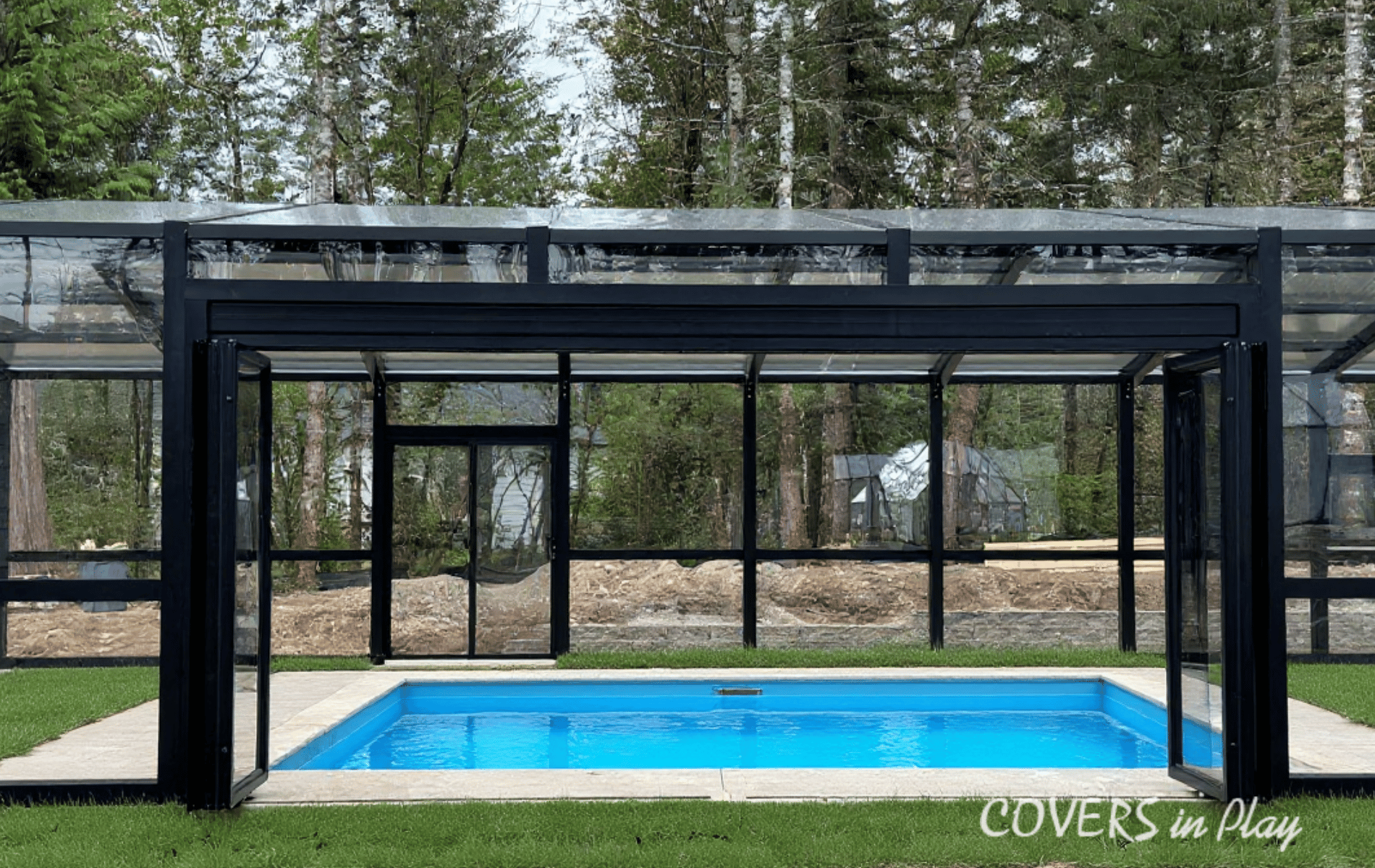
Retractable pool enclosures are engineered structures that slide open or closed to control climate, debris, and access. Ours use a patented automated drive (push‑button motion with safety interlocks), rigid glazing (clear polycarbonate, an impact‑resistant panel, or glass), and sealed, low‑profile tracks (keeps wheels clean and movement smooth). Close during wind, rain, or cold shoulder seasons to retain heat and reduce evaporation; open wide on calm, sunny days for fresh air. Lockable door systems create secure, controlled entry. The result is predictable swim days, warmer water with less energy, and a space that functions like a bright, quiet room—without giving up open‑air swimming.
Day to day, you press a button and swim—no wrestling wet covers. Water stays comfortable longer, and gear works easier because evaporation drops and heat stays in. Families appreciate the clear sightlines and lockable access; coaches and hosts love that lessons and parties go on even when the forecast wobbles. For architects and builders, we provide engineered loads for snow and wind (what the structure safely carries in your climate), drainage planning, and clean profiles that complement the home. And every enclosure comes with a 20‑year warranty—built for daily use, not just nice weather.
If you’re exploring options, start with our swimming pool retractable enclosures
to see how the systems look, move, and integrate with different yards.
Core ways enclosures add measurable value:
Comparison at a glance to choose the right approach for your goals and climate:
| Enclosure Type | Operation | Best For | Typical Cost Range (USD) | Energy/Safety Impact | Resale Appeal |
| Fixed Glass Enclosure | Static | Maximum thermal performance, cold climates | $$ | Highest insulation and safety; zero debris | Strong if architecture matches home |
| Retractable (Aluminum + Polycarbonate/Glass) | Automated sliding sections | Year-round use with open-air option | $$ | Excellent insulation; quick conversion to open pool | Very strong: flexible lifestyle |
| Retractable Dome | Telescopic dome profile | Seasonal or shoulder-season extension | $ | Moderate insulation; compact footprint | Good: budget-friendly extension |
| Screen Enclosure | Static screen | Insect/debris control in mild climates | $ | Minimal thermal gains; basic safety | Moderate: livability boost |
If you prefer a compact, curved profile, take a look at our retractable pool dome enclosures
for streamlined, budget‑friendly seasonal extension.
Real homes and businesses feel the difference on week one. We see two patterns repeat: households turn a short season into a dependable routine, and hospitality spaces unlock predictable revenue. Below are quick snapshots—focused on usable days, cleanup time, and satisfaction—so you can picture results at your place.
These outcomes come from specific design choices—materials, mechanics, and safety systems working together. If you like details, the next step is to review the feature set.
Explore the engineering behind it in our retractable pool enclosure features
—materials, glazing options, sealed tracks, and the patented automated drive that makes daily operation effortless.
Implementation at a glance—what to expect from first call to first swim:
Coming out of your final walk through and automation training, these are the questions we hear most. Codes vary by state and municipality, so we align engineering and permits with your local authority—and confirm specifics during a complimentary design consult.
Q: Do pool enclosures really increase resale value? A: Yes—because buyers see an all‑season outdoor room, safer access, and lower upkeep. That wider usefulness often strengthens offers and shortens days on market. Ask your Realtor to cite local comps and comments in showing feedback.
Q: How much energy can an enclosure save? A: By cutting evaporation and wind loss, heaters run less. DOE (U.S. Department of Energy) guidance notes evaporation drives most heat loss; owners often report noticeable bill drops. Your utility may publish climate‑specific examples.
Q: What about snow and wind loads? A: We engineer to your local loads and provide stamped drawings (engineer‑signed plans) for permits. Profiles, anchors, and glazing are sized to code so the structure performs in your climate.
Q: Is maintenance complicated? A: It’s simple—rinse panels a few times a year, brush or vacuum tracks, and check seals. You’ll handle far less debris, heat loss, and chemical drift than an open pool.
Q: Will it feel like an indoor pool? A: No. Retractable sections open 80–100% on nice days for sky and breeze, then close with a button when weather shifts—preserving that open‑air experience.
If that open‑air, push‑button experience sounds right, claim a complimentary design consult (a $500 value). We’ll map your site, engineer for local snow/wind loads, and show a custom concept with pricing—featuring our patented automated drive and sealed tracks for daily, effortless use. Backed by a 20‑year warranty.
For roof and opening styles, compare how a retractable pool enclosure looks and operates across profiles before you decide.

 905-589-3000