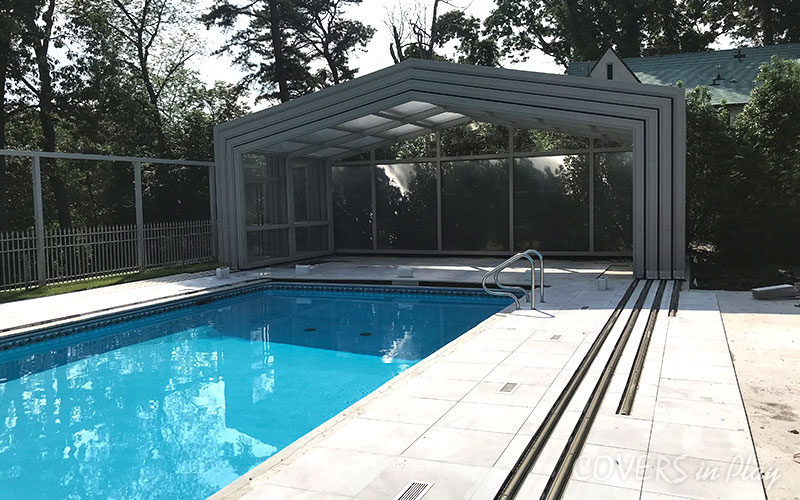
One of the most common misconceptions about pool enclosures is that they are only for new pools, that if your pool is already built and has been in the ground for years, adding an enclosure is either technically impossible or prohibitively expensive.
Neither is true. Adding a retractable enclosure to an existing pool is entirely feasible in almost every case, and it is one of the most common project types that Covers in Play handles. The vast majority of residential pool enclosure installations are retrofits, homeowners with existing pools who have decided they want year-round use, lower maintenance, and a more protected swimming environment.
This article walks through the complete process from the initial assessment to the day you take your first swim in an enclosed pool, so you know exactly what to expect.
The process begins with a conversation and a site visit if required. An enclosure specialist
assess the existing pool and surrounding environment.
The team evaluates:
Pool dimensions and shape. The enclosure is custom-engineered to cover your specific pool footprint. The length, width, and shape of the pool determine the structural configuration of the enclosure.
Deck condition and material. The track system for a retractable enclosure can be embedded in the deck surface or surface mounted. The specialist will assess whether the existing deck is in good enough condition to receive the track installation, or whether modification is needed first.
A note on existing decking: one of the most common concerns homeowners raise is whether the entire deck needs to be replaced to accommodate the track installation. In most cases, it does not. The track can be surface mounted if reviewed and approved by a local structural engineer. Partial concrete or paving work around the track line is maybe required, but a full deck replacement is rarely necessary unless the existing deck surface is in poor structural condition. The site assessment at Step 1 will confirm whether any deck remediation is needed before the installation begins.
Relationship to the house. If you want an attached enclosure which gives direct indoor access to the pool from inside the house the specialist will assess the home’s exterior wall and roof is suitable for the house attachment placement. The house attachment is not structurally attached to the house, but sits in front of the exterior wall and connected with placement of weather seals.
Site constraints. Trees, fencing, utility access points, and neighboring structures all factor into the enclosure design. The specialist identifies any constraints that will affect the design or configuration options.
Local climate. The climate context which drives the structural load specifications and the glazing recommendations for the project.
Following the site assessment, the design team develops a proposal tailored to your pool and property. This is not a catalog selection every enclosure from Covers in Play is designed specifically for its installation site.
The proposal covers:
This is the stage where you can refine dimensions, adjust the configuration, and confirm that the design matches your vision before any manufacturing begins.
For most homeowners, the permitting stage is the one that feels most opaque. Building permits for pool enclosures are required in the vast majority of US jurisdictions, and the process involves more documentation than most home improvement projects.
The permit application for a pool enclosure typically requires:
Covers in Play prepares all of this documentation as part of the project process. The package is assembled and submitted to the local building department on the homeowner’s behalf.
Permit processing times vary significantly by jurisdiction. In many suburban building departments, a pool enclosure permit is processed in two to four weeks. In more congested urban jurisdictions, processing can take six to ten weeks.
Once the permit is approved, manufacturing begins. Covers in Play’s enclosure systems are prefabricated at the manufacturing facility with each component cut, finished, and assembled to the specific dimensions of your project before shipping.
The manufacturing phase typically takes four to six weeks. The aluminum extrusions are cut and finished, the glazing panels are cut to dimension, the drive system components are prepared, and all hardware is packaged and labeled for efficient on-site assembly.
In most retrofit installations, some site preparation work is needed before the enclosure installation begins.
Track excavation and installation: The low-profile track system is embedded in the existing or new deck.
Deck clearance: The area around the pool where the enclosure will be installed needs to be clear of furniture, planters, and any fixed features that fall within the enclosure footprint.
The on-site installation of a residential pool enclosure typically takes eight to fourteen days, depending on size and complexity.
The installation sequence runs:
The commissioning walkthrough at the end of installation is where the Covers in Play site supervisor demonstrates the operation of the enclosure automated drive, operable windows, door operation, and any supplemental features specified for the project.
From the day the installation is complete, the pool is usable year-round. Most homeowners report that the first time they swim in their enclosed pool during weather that would previously have kept them out of the water is a genuinely memorable moment.
That experience, the normality of using the pool in January, the ease of opening the enclosure on a perfect May morning, the comfort of swimming in the rain with the enclosure closed is what a Covers in Play pool enclosure delivers. And it starts the same way for every client: with a conversation about what is possible for your existing pool. Get a quote!

 905-589-3000