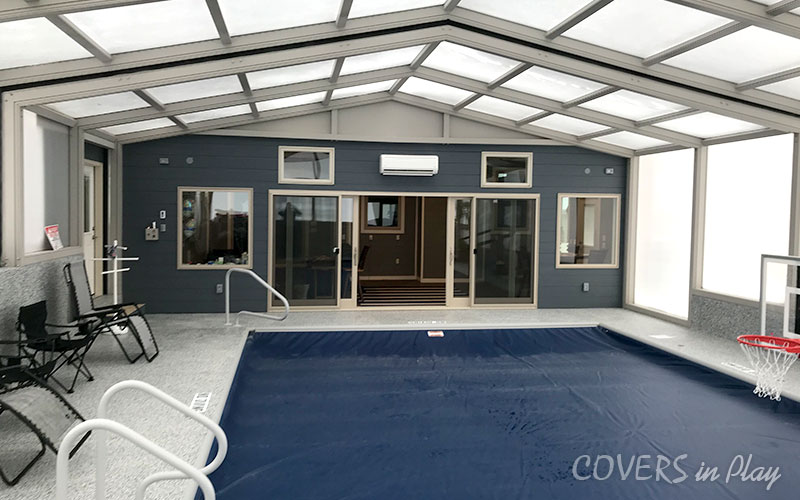
If you’ve ever peeled back a cover to cloudy water and a post‑storm cleanup, you’re not alone. Covers cut evaporation and keep out big debris like leaves and acorns, but they can’t stop windborne dust, humidity, or algae pressure. Real protection and year‑round enjoyment comes from a controlled environment, not a lid, and we’ll show how an enclosure‑first setup changes the math.
So what does a “controlled environment” look like when the wind kicks up? Gusts at 25 mph toss chairs, maple seeds helicopter in, and the yard turns to confetti. Your pool? Neatly covered looks safe, sealed, handled. But fine dust and pollen still ride the gusts, slip past edges, and settle as a thin film you’ll meet tomorrow.
Lift the cover and you spot it: a silt ring on the tile line, a faint yellow pollen sheen, warm, still air beading into condensation. Algae loves that mix quiet water, steady heat, no circulation. The cover did its job reduced evaporation, kept out branches. It’s a tool. Not a shield. So what do covers actually do and where do they fall short?
Myth: A cover equals protection. Reality: It reduces evaporation and accidents but can’t
block wind, UV, humidity, or control water chemistry. Protection requires a controlled environment.
Protection requires a controlled environment so what does a cover actually handle? We see homeowners choose covers to cut evaporation, retain heat, block leaves, and add a basic safety layer. That’s valid. The limits appear in wind, UV (sunlight), humidity, and storms. Use this quick comparison to spot the benefits and blind spots.
| Cover type | Main purpose | What it protects | What it doesn’t protect | Typical cost | Common misconception |
|---|---|---|---|---|---|
| Solar blanket (bubble cover) | Reduce evaporation and nighttime heat loss | Water temperature retention and evaporation reduction | Airborne contamination, storms, and it’s not weight-rated for safety | $100–$800 (size and thickness vary by market) | Heats the pool and protects from everything |
| Mesh safety cover | Safety barrier and large-debris control | Prevents fall-through accidents; blocks leaves and branches | Fine particulates, pollen, water chemistry balance, humidity control | $1,000–$3,000+ installed (size and anchors affect price) | Keeps water perfectly clean without extra maintenance |
| Solid safety cover | Safety plus light blocking to limit algae | Accidental entry prevention; reduces sunlight reaching water | Wind-driven dust, exterior humidity, and structural weather loads | $1,500–$4,000+ installed (weight and spans raise cost) | Blocks all dirt and weather, no cleaning needed |
| Automatic slatted cover | Convenience for daily use and quick closing | Evaporation reduction, heat retention, access control | Storm debris, windborne ash, and ambient humidity | $8,000–$20,000+ installed (size, slats, and drive type affect cost) | Daily use makes other protections unnecessary |
Even a well-fitted cover leaves gaps you feel in real weather: environmental contamination, chemistry drift, structural stresses, energy loss with humid air, and safety liabilities around the pool area.
Out West during fire season, a dry front pushes 30–40 mph gusts and fine ash lands like talc. Even with a cover, that ash slips past edges and coats tile lines contamination and chemistry risk. Then spring pollen spikes; yellow film settles overnight, clogging baskets and eating chlorine. We see cleaning time jump 30–60 minutes per event, plus extra shock and backwash more consumables and more downtime.
In northern zones, freeze-thaw swings crack ice on the cover, then sleet adds weight. Wet snow stacks fast 20–30 pounds per square foot creating load and uplift risk. Along coasts, a nor’easter throws salt spray and sand under edges while humidity stays high. The result is reheating cycles, condensation on metal, and more frequent checks to prevent overstress and stained water.
Add it up over a season: three ash events, four pollen bursts, two heavy snows, and one coastal blow can mean 10–15 extra labor hours, 10–20% more chemicals, and higher energy use from reheats. It’s not catastrophic just constant. And every interruption is a missed swim or cancelled lesson, which is the cost we’ll quantify next.
So what does that constant churn cost in dollars and lost swim days? Here’s a simple model by approach ranges vary by region, climate, and pool size. Focus on total cost of ownership and downtime, not just the price of chemicals or a cover.
| Scenario | Short-term spend | Long-term consequences | Estimated annualized cost |
|---|---|---|---|
| Cover-only winterizing | Winterize kit and cover: $300–$1,500 | Higher spring cleanup, algae shocks, equipment strain; 2–4 lost weekends | Chemicals, labor, parts: $800–$2,000; 6–10 lost swim days |
| Cover + partial maintenance | Monthly service and supplies: $900–$2,400/year | Fewer surprises; still weather exposure and air-quality issues; 3–6 lost days | Total upkeep: $1,200–$3,200; 3–6 lost swim days |
| Year-round operation with enclosure | Installation and setup: moderate–high; financing spreads initial cost | Predictable upkeep, extended use, fewer shocks/repairs; near-zero weather downtime | Operating cost: -20–40% energy/chemicals; 0–2 lost days |
| Reactive cleanups after storms | Low until event; emergency service: $250–$800 per visit | Emergency cleanups, stain removal, repairs; cancellations; 5–12 lost days/year | Totals $1,000–$3,000+; unpredictable, high downtime and stress |
Unpredictable, high downtime and stress isn’t a plan, so we replace it with a simple three-part system. First, a retractable or fixed enclosure creates a controlled microclimate and physical shield against wind, rain, UV (sunlight), and debris. Second, a quality safety/automatic cover manages daily heat retention and access. Third, active systems ventilation/dehumidification (moving moist air out), robust circulation/filtration, and smart monitoring keep conditions stable.
Everything works together, not in silos. Open the enclosure for sun; close in seconds before a storm, then use the cover overnight to lock in heat—evaporation drops 80–95%, and the cover adds another layer. You handle the environment, the surface, and the air, all with simple controls.
Result: clearer water and steadier chemistry, fewer shocks and surprises, and far less downtime. Typical outcomes we see: 30–50% lower chemical use, 20–40% less heater runtime, and near‑zero weather closures across the season. Our patented automated drive system makes retraction effortless, and our 20‑year warranty backs the structure for the long haul.
At the center are engineered pool enclosures that create the controlled environment; the cover and active systems complete the stack next, we’ll map each common risk to the piece that neutralizes it.
As promised, here’s the quick map tying each common risk to engineered features and measurable effects cleaner water, safer access, lower energy, and more uptime then we’ll put it to work in a real before/after scenario.
| Risk | Enclosure capability | Real-world effect |
|---|---|---|
| Contamination & Airborne Debris | Sealed glazing, perimeter gaskets, and controlled air exchange | Dramatic reduction in fine particulates and organic load |
| Water Chemistry & Algae | Light control and stable temperature for water and air | Slower algae growth; steadier sanitizer demand; 30–50% lower chemical use |
| Structural Loads & Weather | Engineered wind and snow load ratings; impact-resistant framing and glazing | Lower damage risk; faster reopen; consistent access immediately after storms |
| Energy Loss & Humidity | Insulating panels plus balanced ventilation/dehumidification for moisture control | Warmer air, less condensation; 20–40% less heater runtime |
| Safety & Liability Beyond the Cover | Lockable doors, defined perimeter, and slip-resistant walking surfaces | Better access control; safer decks; supports clear supervision zones |
With access handled and the deck finally safe, what changes in real life? Last fall you closed with a standard cover, felt “set,” and waited out winter. Spring hit, storms passed, and you lifted the lid to green water, tile stains, and that earthy smell. Two weekends gone to vacuuming, backwashing, and $300–$600 in shock, plus a stained step that never quite came back. The cover reduced evaporation. It didn’t protect your time.
Now contrast the same yard after we add a retractable enclosure and smart cover. A squall blows through at 9 p.m.; you tap close, sleep, and swim at 7 a.m. no debris, no reheat. Within three months, sanitizer demand levels out and chemical use drops 30–50%. Heater runtime falls 20–40%, and there hasn’t been a single weather closure. In January, you’re doing weekend laps in 78–82°F air (comfortably warm) with clear sightlines and zero cold wind.
Here’s the quick snapshot of outcomes our clients see and the numbers you can expect. Next, we’ll help you pick your path: fully indoor integration or retractable flexibility.
Love that 78–82°F air and dry, wind‑free deck? Make it permanent with a fully indoor configuration. If you live in a cold climate, want privacy and security, or need a predictable swim schedule, this is your path. We integrate ventilation (fresh air movement), dehumidification (moisture control), and balanced heat so the room feels crisp, not clammy. Architecturally, we match glazing and structure to your home, plan sightlines, and specify finishes that resist chlorine and salt. Think 6 a.m. laps in January without stepping into sleet.
Comfort lives in the details: thermal breaks (insulated joints that stop condensation), drained tracks, and quiet fans sized for your volume. We coordinate footings and loads with your builder, keep noise targets under typical living‑room levels, and ensure doors lock cleanly for safety. Daily lap swimmers, therapy users, and families with kids love the always‑ready feel towels stay warm, goggles dry, and furniture lasts longer out of UV. It’s your pool, not the weather’s.
See how our approach to indoor swimming pools delivers steady comfort, controlled air, and storm‑proof protection year‑round.
If you want that steady indoor comfort but still crave blue‑sky days, go retractable. Open for sun and breeze, then tap to close before wind, rain, or pollen shows up. Our patented automated drive moves panels smoothly with safety interlocks (sensors that pause if something’s in the way). We tailor spans, glazing, and finishes to your pool and deck so daily use stays effortless.
What does it look like on your deck? Think low‑profile arcs that roll off the waterline, mid‑height segments you can walk under, or a tall gable that meets the house. We build for compact plunge pools, full‑length lap lanes, and family‑size rectangles. Most owners open for lunch, close in seconds at dusk for heat retention and swim after dinner with zero wind‑chill or the buzz of mosquitoes. Ready to use the whole deck, year‑round?
Want design ideas? Explore our retractable pool dome enclosures to compare shapes, spans, finishes, and automation details.
If those retractable options sparked ideas, imagine extending them over your patio. Dinner isn’t cancelled for wind, drizzle, pollen, or mosquitoes close panels and keep the breeze. Furniture stays cleaner, cushions last longer, and covered transitions keep floors drier and safer. More weeknights outside, fewer cleanups, and a space you’ll actually use.
We design patio enclosures that align with your home’s lines and finishes, turning the pool and patio into one cohesive, all‑weather living space. Running a facility? The same design keeps lounges weatherproof and schedules reliable.
If you’re running a facility, reliable schedules aren’t a perk—they’re revenue. An enclosure stabilizes uptime by shielding wind, rain, hail, and pollen while controlling indoor air quality (clean, drier air that keeps chlorine smell and fog down). That means fewer weather calls and less lifeguard idle time. Members notice: no cancelled lessons, warmer decks, more usable hours. We engineer for local wind/snow loads, use corrosion‑resistant framing and hardware near chlorinated or saltwater pools, and back structures with a 20‑year warranty. Fewer closures. Longer asset life.
Compliance gets simpler when the environment is controlled. We design ventilation and dehumidification (moving moist air out to stop condensation drips) to support health codes and protect finishes, and we provide documented load calculations and specs that help permitting move faster. Operationally, you reclaim hours: many sites recover 5–15% of weather‑lost time, turning cancellations into paid lessons or therapy sessions. Pair that with 20–40% lower heater runtime and steadier chemistry, and your OPEX (day‑to‑day operating costs) drops while member value rises.
For specifiers and boards comparing options, our commercial pool enclosures page outlines load ratings, air‑handling strategies, materials, and warranty details you can bring to the next meeting.
You’ve got the specs for the meeting; now here’s the day‑to‑day. Use this weekly, monthly, and seasonal routine for your cover and enclosure 10–15 minutes most weeks, or choose our annual service plan.
You’ve got the post‑storm routine down; now protect your budget before you buy. We use this checklist on every project, ask these upfront to avoid change orders, permitting delays, and mismatched systems.
You asked about timelines and milestones, let’s map them to your site with a complimentary design consultation (a $500 value). In 30–45 minutes, we review goals, climate, and code, then outline phases, permits, and install windows. Our patented automated drive and 20‑year structural warranty anchor the plan.
Expect clear budget ranges (fixed vs. retractable), a site feasibility check (loads, footings, drainage), and a return‑on‑investment snapshot showing 20–40% energy savings and 30–50% fewer chemicals. We also share a realistic schedule by phase so you know what happens when. Ready to see options for your climate and deck layout? Book now and no pressure, just answers.

 905-589-3000