Home improvement decisions are rarely made on financial return alone, but when a project combines genuine lifestyle benefits with a positive impact on property value, the case for moving forward becomes considerably stronger.
A pool enclosure is that kind of investment. It makes your home more enjoyable to live in and more valuable when it comes time to sell. This article explains both dimensions starting with what the research shows about pool enclosures and home value, and extending to the practical reasons why enclosed pools are uniquely appealing to today’s buyers.
The relationship between swimming pools and home value is well-documented. The National Association of Realtors and independent appraisal research consistently estimate that an in-ground swimming pool adds between five and seven percent to a home’s value in most US markets.
That figure is not uniform, it is higher in markets where pool use is year-round and lower in markets with short swimming seasons. The logic is straightforward: a pool that can only be enjoyed for three months of the year contributes less to a buyer’s assessment of a home’s lifestyle value than one that is usable twelve months per year.
This is precisely where a pool enclosure changes the equation.
An unenclosed outdoor pool in a northern state is, from a practical standpoint, a seasonal feature. Buyers evaluating the property know that the pool requires opening in spring, closing in fall, and contributes to the home’s appeal for approximately four months per year.
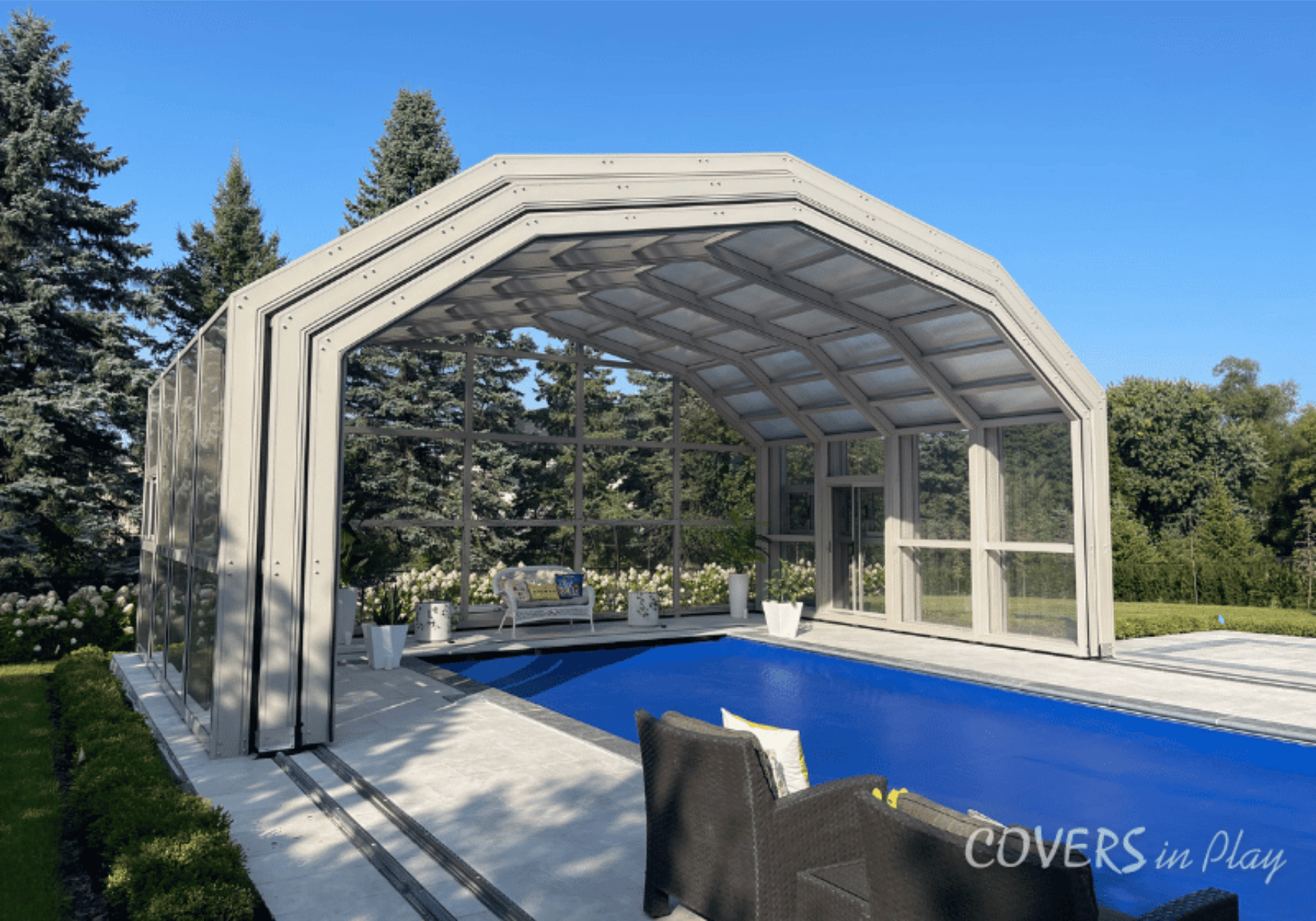
An enclosed pool changes that buyer psychology entirely. A year-round covered pool solution is not a seasonal feature, it is a permanent amenity comparable to an indoor pool, but with the added flexibility of opening fully to the outdoors when weather permits.
That distinction affects the buyer pool for the home. Properties with year-round pool access appeal to a broader range of buyers in cold climates, and a retractable enclosure delivers that appeal while also offering something an indoor pool never can: the open-sky outdoor swimming experience.
Real estate agents who work with high-end residential properties consistently report that an enclosed pool is a memorable feature that differentiates a property clearly in buyer presentations.
One of the objections buyers most frequently raise about properties with pools is ongoing maintenance cost and time commitment. An open outdoor pool requires regular skimming, vacuuming, chemical balancing, and seasonal opening and closing.
A pool enclosure substantially reduces that burden. With the pool protected from debris, weather, and direct UV exposure, water chemistry remains more stable, fewer chemicals are needed, and the physical cleaning time drops dramatically.
For buyers who want a pool but are wary of the maintenance commitment, an enclosed pool actively addresses their primary objection. That is a significant advantage in a buyer conversation.
Energy-efficient homes command premium prices in the current market, and a pool enclosure contributes to that profile in a measurable way.
Heating an outdoor pool is one of the most energy-intensive aspects of home pool ownership. A pool enclosure reduces heating costs significantly through two mechanisms: it traps solar energy to raise the ambient air temperature inside the enclosed space, and it reduces evaporative heat loss from the pool surface by keeping wind off the water.
In a home where energy efficiency is being presented as a selling point through green certifications, solar installations, or upgraded insulation a pool enclosure with documented energy savings complements that narrative directly.
Beyond the functional arguments, a well-designed pool enclosure has genuine architectural appeal. The slim aluminum profiles, clear polycarbonate or glass panels, and clean roofline of a quality retractable enclosure add a visual sophistication to a backyard that photographs beautifully and presents compellingly in a listing.
In a real estate market where first impressions are driven by online listing photography, a property with a striking enclosed pool environment stands out. Buyers who might not have scheduled a viewing based on the listing description will visit a home whose outdoor images convey something genuinely distinctive.
For homeowners considering a pool enclosure partly as a resale investment, the most important single detail is this: Covers in Play‘s 20-year warranty is fully transferable to new owners. That transferability converts the warranty from a personal benefit that disappears at the point of sale into a documented, assignable asset that the new owner inherits. In a competitive listing environment, a pool enclosure with a transferable manufacturer’s warranty is a material differentiator.
Beyond the warranty, the financial return depends on market conditions and buyer demographics. In markets with significant numbers of families, fitness-conscious buyers, or buyers accustomed to luxury amenities, the return tends to be stronger.
For homeowners considering a pool enclosure with a view to both lifestyle enhancement and property value, the investment calculus is compelling across most US markets. To explore what a retractable pool enclosure would add to your specific property, the Covers in Play design consultation is the ideal starting point.

 905-589-3000