You’ve invested tens of thousands of dollars into your pool. Now you’re asking the right question: what’s the best way to protect it?
If you’ve spent any time researching, you’ve likely found yourself comparing pool enclosures vs pool covers. Both claim to protect your water, reduce maintenance, and extend your swim season. But the similarities end quickly once you look at how each system actually performs over time.
This guide breaks down the real differences between covered pool enclosures and traditional pool covers across every factor that matters: durability, safety, cost, maintenance, year-round usability, and long-term return. By the end, you’ll know exactly which option fits your situation and why so many homeowners are moving beyond basic covers entirely.
A pool cover is a sheet or panel system that sits directly on or just above the water’s surface. Its primary function is straightforward: keep debris out, reduce evaporation, and retain some heat when the pool isn’t in use.
Pool covers come in several forms:
Every type of pool cover shares the same core limitation: it protects the water, not the space around it. You can’t swim under a pool cover. You can’t sit poolside in the rain. And you can’t extend your season by more than a few weeks in most climates.
A pool enclosure is an architectural structure built over and around your entire pool area. Think of it as a permanent or retractable building that creates a controlled indoor-outdoor environment, not just a lid on the water.
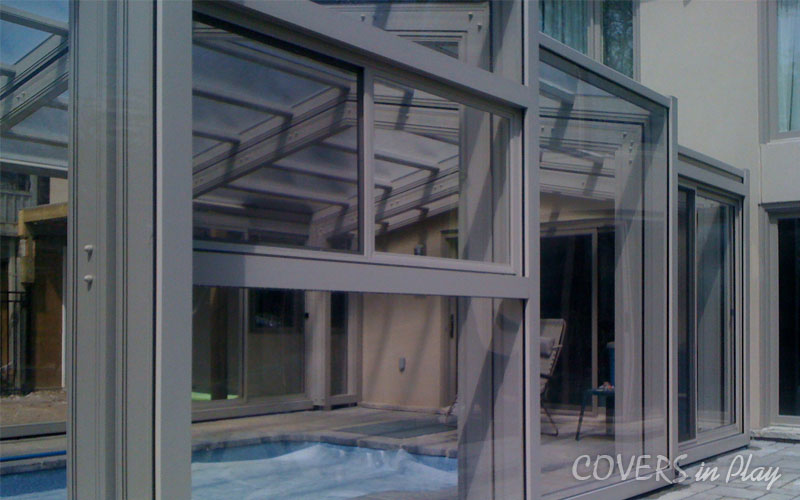
Modern pool enclosures are engineered structures, typically built with extruded aluminum frames and glazed with tempered glass, acrylic, or polycarbonate panels. They’re designed to handle serious structural loads, including heavy snow and high winds, while still allowing natural light to flood the pool area.
Pool enclosures come in two main categories:
The defining difference? A covered pool enclosure turns your outdoor pool into a year-round living space. You swim in January. You sit poolside during a thunderstorm. And your pool stays clean, warm, and accessible regardless of what’s happening outside.
The most useful way to understand the difference between a pool enclosure and a pool cover is to look at them side by side across the criteria that actually affect daily use and long-term ownership.
Pool covers are seasonal tools. Even an automatic pool cover can only extend your season by a few weeks on either end, and you’re still at the mercy of air temperature when you want to swim.
On a chilly day, the water might hold heat, but you won’t enjoy standing poolside in the wind.
Pool enclosures create a greenhouse effect that warms the air and water simultaneously. In much of the US, homeowners with enclosures swim comfortably from early spring through late fall. With supplemental heating, year-round swimming becomes genuinely practical.
A pool cover protects the water from rain, snow, and falling debris. That’s valuable, but it doesn’t protect your pool deck, furniture, or the surrounding infrastructure.
An enclosure shields everything: the water, the deck, the equipment, and the people using the space. It blocks wind, deflects snow loads, and prevents storm damage to your entire pool area.
Structures engineered by Covers in Play are designed with no cross-bracing and are structurally preloaded to withstand heavy snow and high-wind conditions.
Safety covers, when properly installed and anchored, prevent accidental drowning by supporting the weight of a child or pet that wanders onto the cover. Automatic pool covers offer similar protection when closed.
Pool enclosures offer a fundamentally different kind of safety. They create a physical barrier, a walled and roofed structure, that prevents unsupervised access entirely. Many local building codes recognize enclosures as compliant pool barriers, and some insurance providers reduce premiums when an enclosure is installed. For a deeper look at why a cover alone may not be sufficient, see our post on pool cover safety alternatives.
Pool covers are functional, and they look like it. Even high-quality automatic pool covers have a visible track system and a housing unit at one end of the pool. When the cover is deployed, the pool loses its visual appeal.
Pool enclosures, on the other hand, are designed to enhance the look of your property. Aluminum-framed structures with glass or polycarbonate glazing add architectural presence. Retractable enclosures can open fully on warm days, giving you an unobstructed outdoor feel. Closed, they create a bright, light-filled space that looks intentional.
Pool covers demand regular attention. Manual covers need to be physically removed, cleaned, and reinstalled. Solar covers degrade in UV light and require replacement every 2 to 3 years. Safety covers accumulate water and debris on top, requiring a cover pump. Automatic covers have mechanical components (motors, tracks, ropes) that need periodic servicing.
Pool enclosures require far less routine work. The aluminum frame resists corrosion without painting. Glazing panels can be cleaned with water and a soft cloth a few times per year. Because the enclosure keeps debris out of the pool entirely, your filtration system runs less, and chemical usage drops noticeably. Our pool enclosure buying guide details what to expect in terms of upkeep.
Pool covers reduce heat loss through evaporation, which is the largest source of energy waste in an uncovered pool. A good cover can cut heating costs by 50% to 70%.
Enclosures go further. By trapping solar radiation and reducing wind-driven evaporation to nearly zero, they maintain water temperature with significantly less energy input. The enclosed airspace acts as a buffer zone, reducing the temperature differential between the water and the surrounding environment. For pools with gas or electric heaters, this translates directly to lower monthly utility bills.
A standard pool cover adds no measurable value to your property. It’s considered a consumable accessory, like a pool filter or vacuum.
A well-designed pool enclosure, by contrast, is a permanent structural addition. Real estate appraisers treat it similarly to a sunroom, screened porch, or finished outdoor living space. It increases usable square footage and extends the seasonal utility of the property. In competitive housing markets, an enclosed pool can meaningfully differentiate your listing.
For a detailed breakdown of enclosure features and specifications, including glazing options, frame materials, and automation systems, visit our features page.
| Feature | Pool Covers | Pool Enclosures |
|---|---|---|
| Year-round usability | ✖ | ✔ |
| Full weather protection | Partial | ✔ |
| Safety barrier (prevents access) | Limited | ✔ |
| Aesthetic value | ✖ | ✔ |
| Low maintenance effort | ✖ | ✔ |
| Energy efficiency | Moderate | ✔ |
| Property value impact | ✖ | ✔ |
| UV protection for swimmers | ✖ | ✔ |
| Usable poolside living space | ✖ | ✔ |
| Noise reduction | ✖ | ✔ |
| Custom sizing and design | Limited | ✔ |
A pool enclosure is the right choice when your goals go beyond simply keeping leaves out of the water. Here are the situations where an enclosure makes the most sense:
Pool covers aren’t bad products. They serve a clear purpose, and for some homeowners, they’re the right fit. A pool cover is probably sufficient if:
That said, if you find yourself replacing covers every few years, battling debris constantly, or wishing you could swim in September, it might be time to evaluate whether a cover is really “enough” for your needs.
Cost is usually the first question homeowners ask, and it deserves a straightforward answer. Here’s what each option typically costs in North America:
Over 20 years, the total cost of ownership for an automatic pool cover, including installation, fabric replacements, and motor servicing, can reach $30,000 to $50,000.
These figures vary based on pool size, enclosure height, glazing material, automation, and local installation factors. Covers in Play provides custom quotes because every project has different engineering requirements.
Choosing between a traditional pool cover and a covered pool enclosure comes down to how you want to use your pool, not just how you want to protect it. While covers help reduce debris and evaporation, a custom enclosure creates a functional indoor-outdoor environment that extends your swimming season, improves comfort, and adds lasting value to your property.
If you are exploring retractable pool enclosures, fixed structures, or advanced roof systems for year-round use, Covers in Play can help you design a solution tailored to your space and lifestyle. Request a custom quote today and discover how the right enclosure can completely transform your pool experience.
For homeowners who want year-round use, improved safety, and long-term value, yes. A pool enclosure typically lasts 20 to 30 years, reduces chemical and heating costs substantially, and adds measurable value to your property. A pool cover is a lower upfront cost but generates recurring replacement expenses and offers limited functionality.
Yes. Retractable and fixed enclosures can be custom-fitted to existing pools. The process involves evaluating your deck structure, grading, and clearances, then engineering an enclosure that fits precisely. Request a custom quote to start the evaluation process.
An overhead pool cover reduces evaporation and slows heat loss from the water surface. An enclosure does the same while also warming the surrounding air, creating a thermal envelope that keeps temperatures more stable. In cold climates, the difference in heating efficiency can be 30% or more.
In most jurisdictions, yes. Pool enclosures are permanent or semi-permanent structures and typically require a building permit. Covers in Play works with homeowners and local authorities during the planning phase to ensure all regulatory requirements are met.
High-quality pool enclosures use extruded aluminum framing for its strength-to-weight ratio and corrosion resistance. Glazing options include tempered glass, acrylic panels, and polycarbonate sheets. Each material offers different trade-offs between clarity, insulation, impact resistance, and cost.
Aluminum-framed pool enclosures with engineered glazing typically last 20 to 30+ years. Manual pool covers last 3 to 7 years. Safety covers last 8 to 12 years. Automatic pool cover fabrics last 5 to 7 years, though the mechanical system may last 10 to 15 years with servicing.
Retractable pool enclosures are specifically designed for this. Telescoping segments slide along ground-level tracks to open the pool fully. Automated models from Covers in Play use a patented drive system that opens or closes the enclosure with a single button press.
Yes. By blocking UV radiation (which breaks down chlorine) and preventing organic debris from entering the pool, an enclosure can reduce chlorine consumption by 40% to 60%. Less debris also means your filtration system runs fewer hours per day, reducing electricity costs.
Absolutely. Hotels, resorts, aquatic centers, and school facilities use pool enclosures to extend usable seasons and meet safety regulations. Commercial enclosures are engineered for larger spans and higher load requirements than residential models.

 905-589-3000