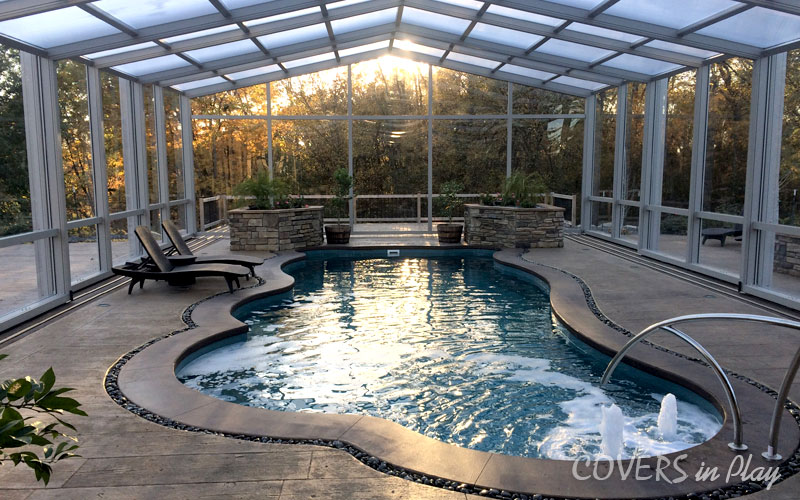
With their elegant appeal and all-season accessibility, indoor pools using pool enclosures are gaining popularity among today’s pool buyers. While adding a dedicated pool room or enclosure can significantly increase the overall cost, it also ensures ideal swimming conditions every day of the year. In many parts of the country, enclosing your pool can transform a short summer swim season into a year-round aquatic escape.
Table of Contents
Indoor pools are the ultimate all-in-one leisure space. Imagine a single room designed for entertainment, fitness, dining, and relaxation. Whether it’s a lush indoor tropical retreat with waterfalls, slides, and greenery, or a streamlined training zone with a lap pool and athletic gear, the indoor pool area often becomes the centerpiece of the home and the place guests naturally gravitate toward. Best of all, you can dive in anytime, rain or shine.
You can build any type of pool indoors fiberglass, gunite, or vinyl-lined and the design can range from a simple lap pool to a full-scale indoor water park. Many homeowners enhance their indoor pool areas with features like gyms, steam rooms, saunas, wet bars, changing rooms, showers and more to create a spa-like experience. The only limits are your imagination and budget.
Indoor Pool Construction and Cost
The ideal time to plan an indoor pool is during the design phase of a new home. However, with skilled architectural guidance, it’s also possible to integrate one into an existing structure. Either way, working with an architect experienced in indoor pool design is essential.
Indoor and outdoor pools are built similarly, with one key difference: outdoor pool decks slope away from the pool to prevent debris from entering, while indoor decks slope toward the pool to keep water from reaching the walls. Since indoor pools aren’t exposed to freeze-thaw cycles, builders can use a wider range of materials, including smaller glass and ceramic tiles.
While an indoor pool room may visually match the rest of the home, however the engineering is far more complex especially when it comes to heating and ventilation when using standard construction material. Maintaining comfortable humidity levels is critical, and in some cases, the cost of air quality systems can rival the cost of the pool itself. A complete indoor pool setup, including the structure, typically starts between $175,000 and $300,000.
Indoor Pool Ventilation
Maintaining proper air quality in an indoor pool environment is essential for both comfort and structural integrity of the building. Ideally, humidity levels should stay between 50% and 60%, achieved either by exchanging moist air with fresh, dry air or by installing a dedicated dehumidification system. These systems must be carefully designed to avoid directing airflow across the pool surface, which will accelerate evaporation. Instead, air should be distributed evenly along the walls to prevent condensation.
When the air temperature matches the pool water temperature, the space reaches its dew point. To reduce evaporation and improve swimmer comfort, the air inside the room should be kept two to four degrees warmer than the pool water. If the temperatures drift apart, evaporation increases leading to condensation on windows, doors and even a “raining” effect inside the room is possible. Since many pools are heated to around 82°F, raising the room temperature to 84–86°F isn’t always practical, making a properly sized dehumidification system essential.
Evaporation can also be minimized by limiting the use of water features. Plumbing fountains and waterfalls separately from the heated pool water helps keep them at room temperature, reducing their impact on humidity. Automatic pool covers are another highly effective solution, capable of cutting evaporation by up to 50%. These covers can reduce dehumidification costs by hundreds of dollars per month of operating cost.
Proper deck drainage is also important. Preventing puddles helps lower ambient moisture levels. A sleek strip drain around the pool’s edge offers a cleaner look than traditional hub drains spaced every 8 to 10 feet. For added comfort and dryness, radiant floor heating systems can eliminate standing water and keep bare feet warm during colder months.
Indoor pools are essentially bodies of water in a confined space, and as such, have special requirements that must be adhered to if the room is to be functional. Trouble can start when the indoor climate is not properly managed. The most effective way to regulate the indoor climate of a pool room is by using a dehumidification system that’s accurately sized to handle the specific air volume and moisture levels helping prevent issues like mold, corrosion, and structural damage.
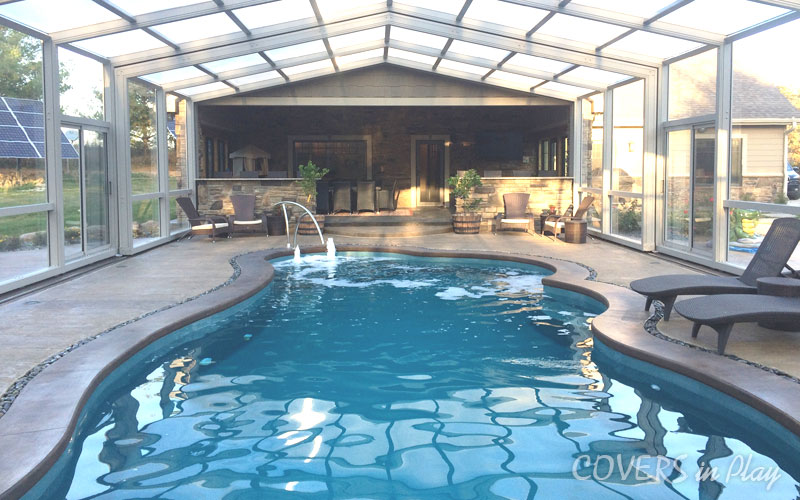
However, retractable aluminum pool enclosures offer a unique advantage. Unlike traditional indoor pool rooms built with standard construction materials, these enclosures can be opened to allow natural airflow, dramatically reducing humidity without the need for complex HVAC systems. Even when closed, their design supports passive ventilation and simple air exchange, making them a cost-effective alternative to conventional dehumidification. By integrating climate control into the structure itself, retractable aluminum enclosures provide a streamlined, energy-efficient solution for maintaining a comfortable indoor pool environment.
Ventilation remains a key factor, especially in rooms with extensive glass features like windows, skylights, and sliding doors. These surfaces trap heat and contribute to humidity buildup. Additionally, chlorine-based sanitation produces chloramines, which can create strong odors. Strategic vent placement ensures proper airflow across glass surfaces, helping maintain a fresh, breathable atmosphere throughout the space.
Indoor Pool Structures
In any indoor pool environment, moisture management is critical. Plastic vapor barriers are typically installed behind walls to prevent water from reaching structural framing, where it can lead to mold growth and freeze/thaw damage. Builders may use materials like greenboard (a water-resistant drywall commonly found in bathrooms), waterproof cement boards such as Wonder Board, or even Dryvit, an exterior-grade finish available in various textures and colors. While these materials offer some protection, they are not immune to long-term moisture exposure.
Even with a well-designed HVAC and ventilation system, standard construction materials will eventually be susceptible to moisture-related issues. That’s because air circulation in enclosed spaces is rarely uniform, allowing pockets of humidity to linger and settle into walls, ceilings, and framing. Over time, this uneven airflow can lead to mold, corrosion, and structural degradation regardless of how advanced your climate control system is.
This is where aluminum pool enclosures offer a distinct advantage. Engineered specifically for wet environments, these enclosures resist moisture naturally and promote better air movement throughout the space. Their non-porous surfaces and integrated ventilation features help eliminate the need for complex dehumidification systems, making them a durable and cost-effective solution for long-term indoor pool performance.
When planning your pool’s mechanical systems, don’t overlook the equipment room. Pool builders often recommend allocating more space than architects typically design, ensuring there’s enough room for maintenance, repairs, and future upgrades. If your pool will be serviced by professionals, consider placing the equipment room near an exterior access point to avoid technicians needing to pass through your home.
Pools sanitized with chlorine will inevitably produce chloramines—compounds responsible for the strong “pool smell” often associated with indoor facilities. While ventilation systems help reduce these odors, additional solutions like ozonators or mineral purifiers can further minimize chloramine production and improve air quality.
Product Comparison: Traditional Indoor Pool Construction vs. Retractable Aluminum Pool Enclosures
| Feature | Traditional Indoor Pool Construction | Retractable Aluminum Pool Enclosure |
| Moisture Resistance | Relies on vapor barriers and water-resistant materials (e.g., greenboard, Dryvit) | Naturally moisture-resistant aluminum framing |
| Mold Risk Over Time | High, especially in areas with uneven airflow | Low, due to better air circulation and non-porous surfaces |
| Ventilation Requirements | Requires complex HVAC and dehumidification systems | Often sufficient with natural ventilation or simple air exchange |
| Climate Control | Must maintain precise air/water temperature balance | Can be opened to regulate temperature and humidity naturally |
| Installation Cost | Higher due to structural reinforcements and mechanical systems | Lower overall due to reduced HVAC needs and simpler design |
| Maintenance Costs | Ongoing HVAC servicing, mold prevention, and material upkeep | Minimal, with fewer mechanical components and corrosion-resistant materials |
| Design Flexibility | Customizable but limited by structural and HVAC constraints | Modular, retractable, and adaptable to seasonal use |
| Energy Efficiency | Dependent on HVAC system performance and insulation | High, with passive ventilation and reduced energy consumption |
Indoor Pools with Retractable Roofs and Skylights
Incorporating windows, skylights, and sliding glass doors into an indoor pool design creates a bright, open atmosphere, but it can also contribute to excessive heat buildup during the summer months. To mitigate this, it’s essential to include operable skylights or high windows that allow hot air to escape. Without proper ventilation, cooling costs in the summer can easily surpass winter heating expenses.
A more versatile solution is to install a retractable roof system or enclosure, which allows the indoor pool to function like an outdoor pool during warmer seasons. Large sliding glass doors further enhance this flexibility, offering seamless airflow and a stronger connection to the outdoors.
To prevent window fogging, consistent airflow across the entire surface of each pane is crucial. Architects often recommend placing vents both at floor level and near the ceiling adjacent to each window to maintain clear visibility and reduce condensation.
Indoor Pool Lighting
Natural light plays a vital role in creating a bright, inviting indoor pool environment. Skylights, large windows, and sliding glass doors allow sunlight to flood the space during the day, reducing the need for artificial lighting and enhancing the overall ambiance. Retractable roofs take this a step further by maximizing daylight exposure through transparent roofing panels and open-air flexibility. When fully opened, they transform the indoor pool into an outdoor oasis, allowing fresh air and sunlight to pour in effortlessly.
As evening falls, well-planned lighting becomes essential for safety and enjoyment. A thoughtful combination of underwater lights and wall sconces typically provides sufficient illumination while maintaining a warm, relaxing atmosphere. Overhead fixtures are best avoided, as replacing bulbs in high, moisture-prone areas can be difficult. For ceiling-level lighting, fiber-optic systems offer a smart alternative they use remote illuminators that are easy to access and maintain.
Lighting should be subtle and intentional and just enough to set the mood without overwhelming the space. Overly bright fixtures can create glare and draw unwanted attention through expansive glass surfaces. With retractable enclosures, the transition from natural daylight to ambient evening lighting is seamless, offering both aesthetic appeal and functional versatility.
Ultimately, an indoor pool gives you full control over your aquatic environment regardless of the season or weather. If you’re considering building a pool, starting with an indoor design ensures year-round comfort and efficiency. Retrofitting an outdoor pool into an enclosed space later can be just as costly as building a new indoor pool from scratch, so planning ahead is key.

 905-589-3000