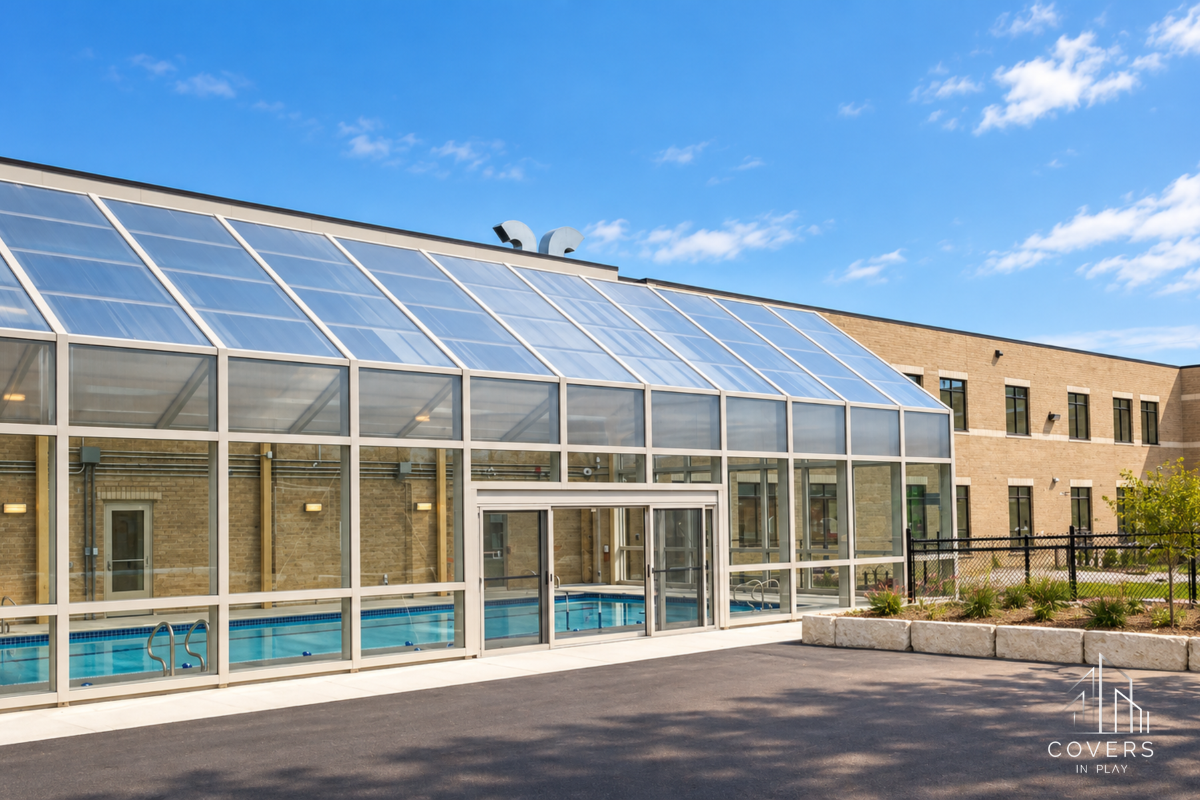
A backyard pool sits closed for weeks at a time. A school pool or a corporate wellness pool doesn’t get that luxury. Between morning swim team practice, gym class rotations, lunchtime lap swim for staff, and evening community programs, an institutional pool can see more traffic in one week than a home pool sees in a season.
That difference changes what an enclosure needs to do. Covers in Play designs retractable and fixed enclosure systems for educational institutions and commercial venues where the pool is a scheduled resource, not an occasional amenity, and where downtime has a cost attached to it.
A rained-out practice at a private club is an inconvenience. A rained-out swim unit in a physical education curriculum, or a cancelled meet for a varsity team, means rebuilding a schedule that was set months in advance. An enclosure takes the weather out of that equation, so the pool is available whenever the timetable says it should be.
Multi-lane pools built for schools and colleges are wide, often 25 yards or more across, with no room for support columns breaking up the lanes. Covers in Play’s automated drive systems use minimal cross-bracing and a preloaded structure, which is what makes a large, unobstructed span possible over a pool that size without a support post in the water.
Constant use also means constant exposure to debris, UV, and temperature swings that push chemical and filtration demand higher than a residential pool ever sees. Closing the enclosure between sessions cuts down what the pool is exposed to overnight and between classes, which is where most of that added load comes from.
A corporate wellness pool is often the amenity that gets used least, not because employees don’t want it, but because it’s only open in good weather during a narrow window around lunch. An enclosure turns it into something facilities can actually schedule around: a fitness class, a physical therapy contract, an early-morning lap swim block, on a day in November as much as a day in July.
Architects and builders working on a new aquatic center can design the enclosure’s footing and drainage into the building plans from day one. Retrofitting an enclosure onto a pool that’s already running programs is a different project: it has to work around an existing deck, existing mechanical systems, and a facility that can’t sit closed for months. Covers in Play offers design consulting for architects specifying pool enclosures, covering both new builds and retrofit projects across a range of climates.
A school board or a commercial property owner is signing off on a structure that has to meet local building and safety codes on a facility with public liability exposure, not a backyard project. Covers in Play’s systems are built to comply with local regulations, and framing, glazing, and drive components carry industry-leading warranty coverage, which matters when the buyer is a board or a facilities department rather than a single homeowner.
Design guidance, project quotes, and installation for a project like this run through Covers in Play’s commercial retractable enclosures program and its dealer network, the same process whether the site is a hotel pool, a school natatorium, or an office wellness center.
Most retrofit projects are staged around the facility’s existing schedule rather than requiring a full closure. The exact sequencing depends on the pool’s deck layout and mechanical access, which is something to work through during the design consultation rather than assume either way.
The drive system scales to the span and the load, not the type of building. A wide, column-free institutional pool needs a larger automated system engineered for that span; the underlying drive technology is the same one used on large residential enclosures.
That’s coordinated through the design and consulting process rather than left to the school or property owner to sort out separately. It gets folded into the same project management that covers the quote, the engineering, and the installation.
Less debris and UV exposure overnight means less for the filtration system and chemical dosing to work against the next morning, though the exact reduction depends on the facility’s current exposure and how many hours a day the enclosure stays closed.

 905-589-3000