
First cold snap hits. You step outside, leaves skitter across the deck, and steam off your spa vanishes in seconds. Over the fence, a second‑story window blinks on; you feel watched. The tub you saved for? Tonight it’s a leaf collector. Sure, a basic cover traps heat while it’s shut. It doesn’t make that walk warmer, or keep eyes away, or stop the gusts. So what are most owners missing?
Your towel chills on the rail in a minute, and a quick gust flips the lid just enough to dump warmth. You skim a few leaves, check the sightlines again, and rethink the soak. Truth is, you skip it more nights than you use it. We hear this every fall and spring. A cover protects water, not you. That gap—comfort, privacy, real protection—is why so many spas sit idle.
That’s where a modern, retractable spa enclosure changes everything. It doesn’t just block wind; it makes stepping out easy, keeps eyes out, and keeps heat in—so you use your spa more, with less cleanup, fewer chemicals, and lower energy spend. In the next section we’ll break down the hidden costs you’re paying now, then quantify real savings and show smart design options that fit town decks, courtyards, and wide backyards.
Let’s break down those hidden costs you’re paying now: weather swings, debris, and sight lines all change how your spa behaves and how often you use it. Wind strips heat the moment the cover’s off, while UV (sunlight) burns off sanitizer faster. Leaves and pollen clog filters, so you spend more time cleaning than soaking. Snow or rain? You cancel the session. Even diligent owners face heat loss, cloudier water, and awkward visibility. When you skip soaks, your cost‑per‑use climbs—and the spa’s ROI drops.
Maintenance compounds. A gusty night means a skimmer full of needles, a filter rinse, and a shock treatment you didn’t plan. Cold air steals 2–3°F in minutes, so you overheat the water beforehand and overpay on energy. Winter paths ice over; summer storms blow grit under the lid. Filters load sooner, pumps work harder, and you refill more often. Most owners intend 3–4 soaks a week but end up at one. Inconsistent use quietly erases the value you bought the spa for.
Preview evidence we’ll share: typical reductions in cleaning time, improved heat retention, and better safety compliance with lockable access—plus design paths from compact domes to sleek retractable roofs.
Saturday night, you lift the lid and find pine needles, a beetle, and cloudy water. Ten minutes of skimming becomes twenty, and the filter icon starts flashing again. While you clean, steam escapes and the temperature drops—so the heater runs longer and your bill inches up. A neighbor’s upstairs light clicks on and the vibe shifts from relaxing to self‑conscious. Meanwhile, the dog noses close and you worry about kids wandering out. The tub sits open, looking like an afterthought in the yard.
Wednesday, you squeeze in a quick soak. A gust lifts the edge of the cover, dumping heat. By the time you get in, it’s cooler than you like—and reheating later costs more. Privacy screens help a bit, but debris still drifts in and sanitizer fades faster, so you shock more often. You keep one eye on the gate latch, hoping the kids stay inside and the cat doesn’t leap up. Instead of unwinding, you’re managing problems you didn’t plan for.
First snowfall. You meant to soak under the stars, but the deck is slick and the cover is waterlogged from last week’s thaw. You wrestle it open, brush off slush, and watch flakes land in the water. Filters clog again by morning. The pop‑up canopy you tried creaks in the wind and looks temporary at best. You close everything up and head inside. Another missed session, another reminder that piecemeal fixes don’t solve comfort, cost, safety, or how the spa looks.
Summarize the friction drivers in a quick scan-friendly list before dissecting why they persist:
Thermal covers do one job well: they trap heat when closed. The moment you open them, wind and convective loss take over, and you’re back to shivering between dips. Privacy screens hide sight lines, but they don’t stop overhead debris or retain warmth around the bather. Pop‑up canopies and tents feel helpful on calm days, yet they struggle with snow loads, pool condensation (moist air that condenses on cold surfaces), and they look temporary. Safety remains a patchwork of latches, gates, and reminders that are easy to forget.
We also see water chemistry drift with these half measures. UV exposure (sunlight that degrades sanitizer) and wind drive off disinfectant, so you shock more and clean filters more often. Temporary structures rarely carry stamped load data (engineer‑verified ratings), so they may not meet code or satisfy insurers. In winter, makeshift shelters trap condensation, inviting mildew and slippery surfaces. In summer, airflow is inconsistent, so hot, gusty days cut sessions short. You’re investing time and money, yet usage stays sporadic and the benefits don’t stack.
Only an integrated structure tackles comfort, cost, safety, and aesthetics at once—and it reliably increases how often you actually soak. The modern answer: a retractable, engineered enclosure designed for true four‑season performance.
💡Explore Your Options
Explore design options with a complimentary design consultation (a $500 value) from Covers in Play—available to US homeowners and commercial properties. We’ll review photos, layout, and climate, then outline smart, code‑ready solutions.
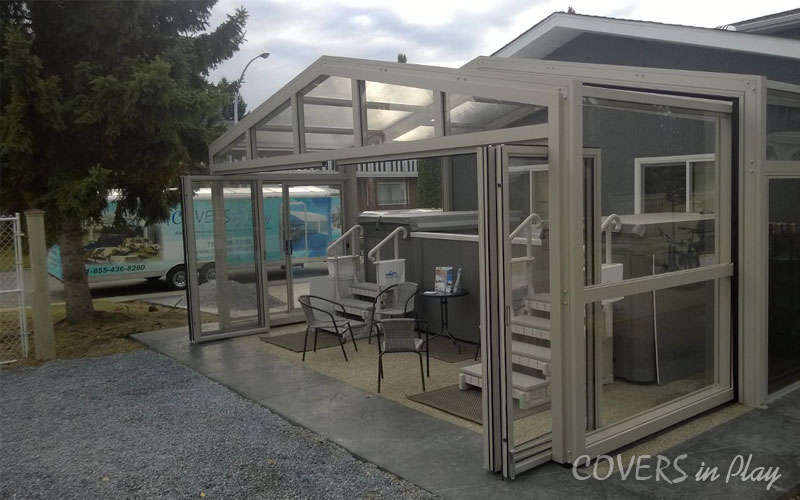
An engineered enclosure surrounds your spa with clear, insulated barriers that block debris and break the wind, so heat stays stable even with the cover open. By reducing evaporation (the biggest heat loss) and shielding from UV, water chemistry holds steady longer with fewer shocks. Sight lines are handled with glazing choices—clear where you want views, translucent where you want privacy. Access is lockable, satisfying barrier requirements in many jurisdictions, and door hardware integrates child‑safe functions. Result: warmer water, cleaner water, and a space that actually feels relaxing.
Ventilation matters too. Operable panels move fresh air to prevent stuffiness and condensation, while keeping the space calm on gusty days. In summer, you retract sections for open‑air soaking; in winter, you slide them closed and step out to warmth. Because the structure is engineered, it’s rated for your climate’s snow and wind loads (the forces from storms), and the footprint can be tailored to your deck, pavers, or yard. The net effect is simple: fewer chores, safer access, and longer, better soaks.
Our edge is practical and proven: a patented automated drive system for effortless operation, durable materials engineered for snow/wind loads, and a 20‑year warranty. We custom‑size and finish each enclosure to match your architecture and landscape, so it performs hard and looks intentional.
Naturally suggest related solutions: For larger projects, explore covered pool enclosures and comprehensive swimming pool retractable enclosures. For design inspiration, see retractable pool enclosures.
Choose what fits your space: low‑profile domes that hug the tub, mid‑rise walkable designs, or full‑height rooms with a retractable roof. For compact yards, consider retractable pool dome enclosures—and if you’re comparing formats, our pool dome overview shows dimensions and use cases.
If you’re comparing a retractable pool enclosure vs. a dedicated spa structure, start with our retractable pool enclosure overview.
Picture your week. Monday night: you tap a button, panels glide, and you step into calm air—no wind biting your shoulders. Thursday: the sun’s out, vents open, and you soak in shade with a soft cross‑breeze. Saturday morning: zero pre‑soak scramble because nothing drifted in overnight. Automation means one‑person operation, no wrestling with wet covers or tarps. You close up just as easily, locking doors on the way in. The difference shows up fast: more spontaneous sessions, better recovery, and real downtime.
Friends drop by on a rainy afternoon and you don’t cancel—you slide sections into place and keep the conversation going. After a workout, you’re not second‑guessing the walk across an icy deck. You’re inside a clear, dry space that still feels outdoors. On hot days, retract halfway for airflow; on cold snaps, keep it closed and toasty. Every setup is tailored, but the rhythm stays the same: fewer barriers to use, predictable comfort, and a spa that becomes part of your daily routine.
Day to day, maintenance drops. With fewer contaminants entering water, filters run longer between rinses and cartridges last more seasons. Reduced evaporation and UV exposure keep sanitizer levels steadier, so you shock less and chase fewer imbalances. Enclosed access keeps walkways drier and easier to make non‑slip, which means safer footing in winter and after storms. Lockable doors add peace of mind around kids and pets, especially when you’re not outside. Less hassle, less waste, and a system that stays dialed in.
Use this comparison to understand where savings accrue. Values illustrate common ranges; your exact results depend on climate, usage, and system size.
| Scenario | Energy Use (Heating) | Maintenance Time/Week | Safety & Access | Expected Payback |
| Exposed hot tub | Higher due to wind/evaporation | 60–90 minutes | Open access; add-on latches | N/A |
| Basic cover only | Moderate improvement; heat loss during use | 45–60 minutes | Partial barriers; minimal privacy | N/A |
| Temporary canopy/screen | Minimal thermal benefit; wind still hits | 40–55 minutes | Limited safety; weather risk | N/A |
| Retractable enclosure | Improved heat retention; reduced cycling | 15–30 minutes | Lockable doors; controlled entry | 2–5 years |
Less hassle, less waste—great. The unexpected win owners report is use jumps 2–3x, which lowers cost‑per‑soak and boosts wellness while weekly chores drop to 15–30 minutes. Energy and chemical spend stabilize because heat stays in and UV (sunlight) stays out. Want your numbers? Request a personalized savings estimate during your complimentary design consult; we’ll factor your climate, rates, and soak habits into a clear payback timeline.
Use this checklist to streamline decisions and discuss the right specs during your consultation.
For inspiration and specs, browse retractable pool enclosures and compare compact retractable pool dome enclosures.
Here are concise answers to the questions we hear most:
That 20-year warranty you just read about is our promise it will last. If it sounds like the right fit, book a complimentary design consultation (valued at $500). We’ll design a retractable enclosure that gives you year‑round comfort, real privacy, safer access, and far less maintenance. You’ll see how our patented automated drive makes one‑touch operation part of your daily routine. US homeowners and commercial properties are welcome.
Ready to move? Book your complimentary design consultation (valued at $500). You’ll receive a concept sketch, climate‑ready load guidance (snow/wind ratings explained in plain English), and a clear budget range—so you can decide with confidence. We’ll confirm year‑round comfort, privacy, safety, and reduced maintenance for your site, and we’ll show the patented automated drive and 20‑year warranty in action. Share a couple photos and rough dimensions to start; we’ll handle the rest.

 905-589-3000